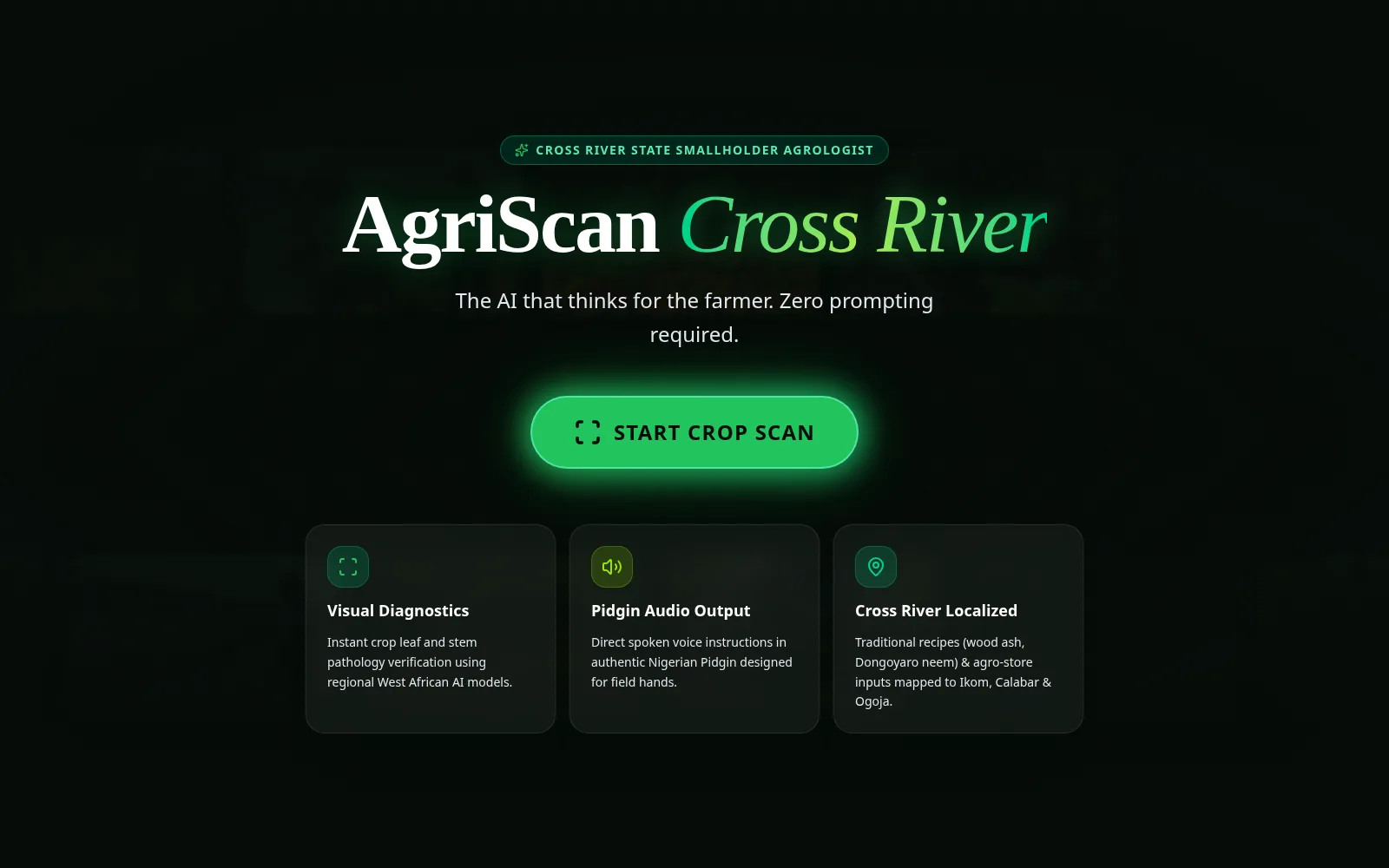
AgriScan Cross River web app
Photograph a sick crop, get a diagnosis spoken in Pidgin.
Limit: Needs a connection to diagnose. Offline mode is still on the plan.
- Role
Full-Stack Developer (AI-Assisted) & Technical Writer
- Status
Front end deployed. Diagnosis runs through the app’s own server and a Gemini key.
- Stack






The problem
Smallholder farmers in rural Cross River work far from the nearest extension officer. A diseased cassava or cocoa plant waits days for an expert opinion, and the answer arrives in language and formats that are hard to act on in a field.
What I built
I researched the field constraints first — patchy connectivity, low confidence with written English, regionally specific pests and remedies — then designed the flow around them: a camera-first capture, one dominant action per screen, plain-language results, and spoken guidance in Pidgin. Regionally anchored advice (wood ash, Dongoyaro neem, local agro-stores) replaced generic global recommendations.
- React 19 + Vite + TypeScript + Tailwind CSS interface with infinite canvas landing and camera capture via getUserMedia.
- Express server exposing POST /api/diagnose, calling the Gemini API with a typed response schema for structured diagnosis output.
- Six supported crops — cassava, cocoa, oil palm, maize, plantain and yams — with a severity read and a next-steps path.
- Bundled agronomy guide mapping symptoms to treatment, sourced from local practice rather than generic library advice.
- Pidgin narration of results through the browser speech-synthesis API, so guidance works for field hands who read English with difficulty.
- A parallel FastAPI service in Python mirroring the same diagnosis contract, for teams that prefer a Python backend.
- Deployed as a Vite build with a Node server bundle; source and history are public.
The result
A working crop-scan flow that opens in a browser on a phone, captures a leaf image, returns a named problem with severity, and reads the advice aloud. The full implementation is inspectable in the repository and the interface is live at the deployment below.
What it does not do
No service worker is registered, so the offline cache is planned rather than implemented — the app needs a connection to diagnose. Diagnoses are not persisted to local history (the “cache” label in the UI is cosmetic). The client reads narration from the browser speech API while the server-side text-to-speech endpoint is left unwired. The bundled sample images are generated placeholders, not photographs. The deployed build points its API base at a temporary tunnel URL, so diagnosis works reliably when the server is run from the repository.