Calabar Fringe Festival website
A live launch site for a festival opening in December.
Limit: Figures on the page are targets for a festival that has not run yet.
- Role
Full-Stack Developer (AI-Assisted) & Technical Writer
- Status
Deployed and serving. The festival itself is scheduled for 18–20 December 2026 and has not taken place.
- Stack


The problem
A first-year festival has no track record to point at. It has to look credible enough that artists submit work and partners commit money before anything has happened, explain what a “fringe” is to an audience that has never had one, and make both asks — send us your work, fund us — actionable on a phone on a Nigerian mobile connection.
What I built
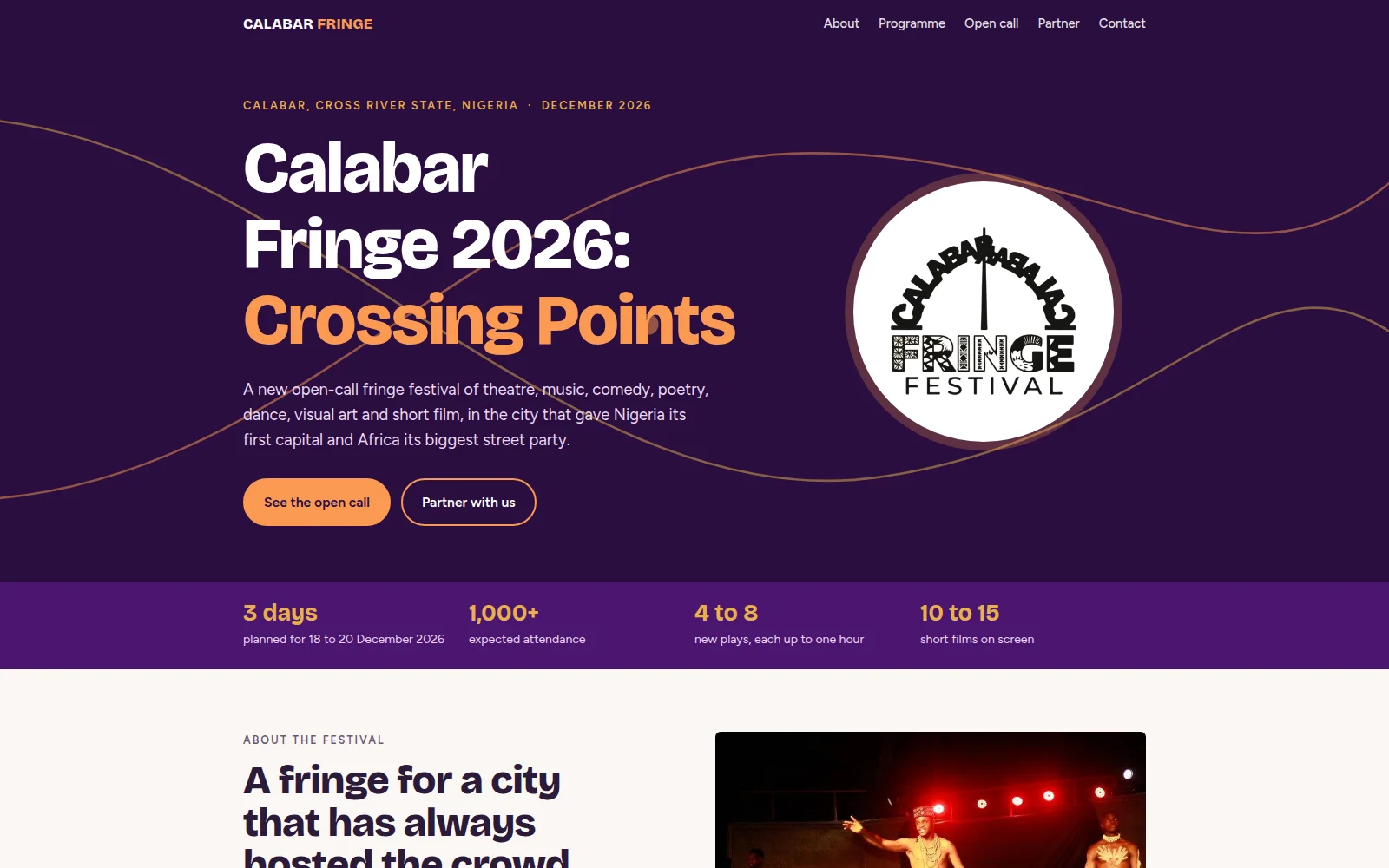
I answered the credibility problem with specifics instead of adjectives: real dates, real programme strands, and concrete numbers for what the first edition intends to stage. The page then follows the order a reader commits in — what it is, how to take part, how to support it — and both asks work through copyable contact details rather than a form, so nothing depends on a backend.
- One self-contained HTML document published with no build step, no framework and no dependency tree — the styles, the base layer and all five images are inlined, so the page is a single request.
- Seven sections on one page: a plum hero, then about the festival, programme, open call, a “why” argument, the partner offer and contact, behind a five-link sticky nav.
- Programme modelled as five strands — new plays, short films, shorter performances, workshops and panels, and a visual art exhibition.
- Open call and partner sections offering three support routes — cash, in kind and services — with copy-to-clipboard contact controls backed by a text-selection fallback when the clipboard API is unavailable.
- Responsive layout with safe-area insets for notched devices, eleven media queries including a reduced-motion block, fluid type through clamp(), and deployment from a public repository to Vercel.
The result
A live festival site that states what the first edition will stage, opens the call for work and the call for partners, and gives both audiences a way to act on the spot. The deployment and the source are public and linked below.
What it does not do
This is an AI-assisted build, not hand-written engineering — the delivered file carries a claude: viewport meta tag — so it evidences writing, structuring and shipping more than manual depth. Every figure on the page (three days, 1,000+ expected attendance, four to eight new plays, ten to fifteen short films) is a target for a festival that has not run yet, not a result. There is no form, booking flow or CMS: the open call runs on copyable contact details, and changing any copy means editing the single file and redeploying. Fonts load from Google Fonts, so the page is not fully self-contained offline, and it ships with no meta description, no social preview tags and no favicon.