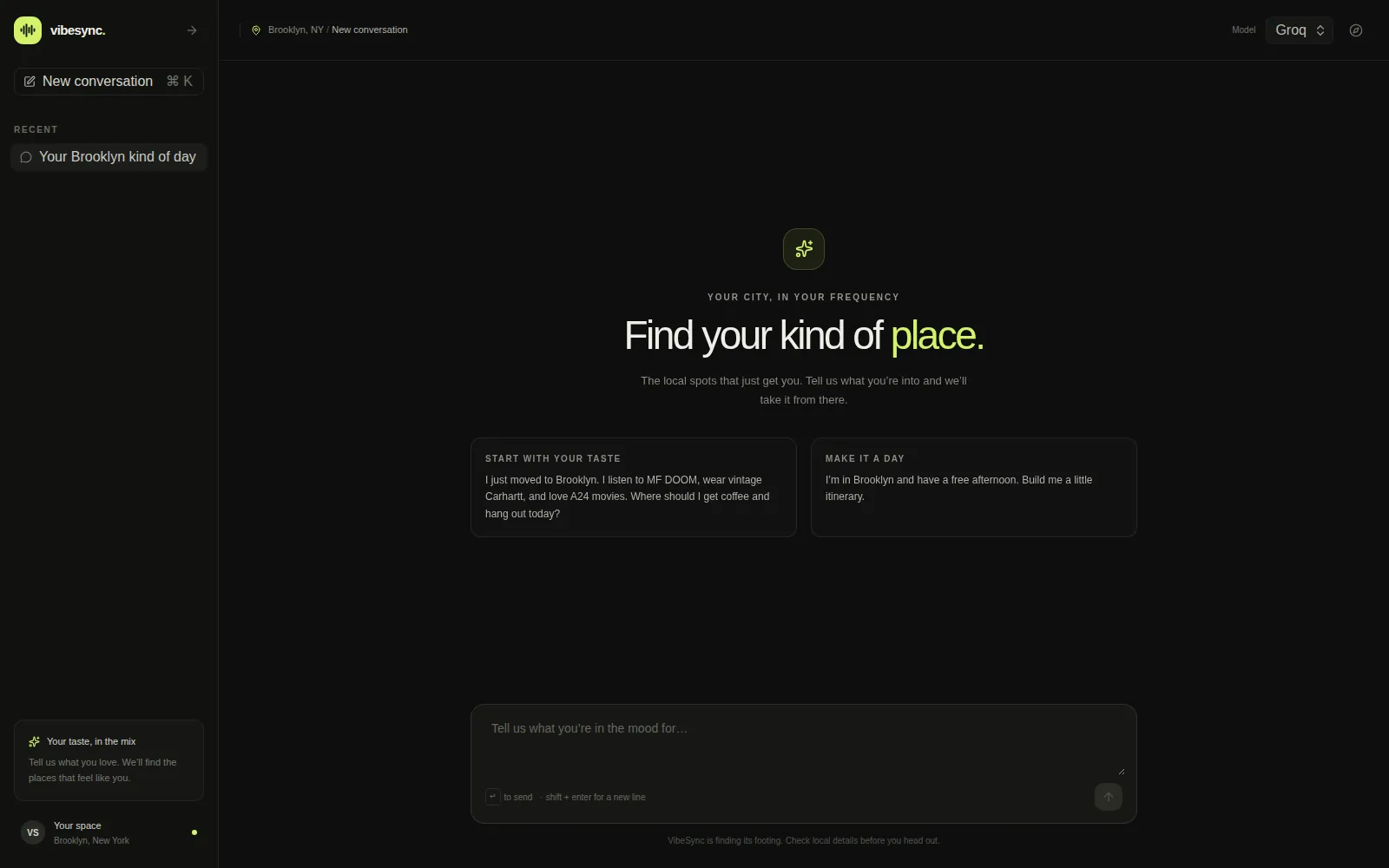
VibeSync web app
An AI agent matching places to your taste, on mock venue data.
Limit: Taste and venue data are mocked, so results show the pipeline at work.
- Role
Full-Stack Developer (AI-Assisted) & Technical Writer
- Status
Deployed. The language-model pipeline is real; the place-data providers are mocked.
- Stack





The problem
Generic “things to do” search answers a location question and ignores identity. It cannot tell you why a bar suits someone who listens to MF DOOM and watches A24 films, so every result reads like an advertisement.
What I built
Rather than one open-ended prompt, I designed a deterministic three-step agent: read the visitor’s taste, recall candidate venues, then compose a reasoned card. Structuring the pipeline with an explicit step function keeps each result explainable — the card has to state the cultural anchors it matched on rather than asserting relevance.
- Next.js App Router + TypeScript + Tailwind CSS application, deployed on Vercel.
- Streaming chat interface built on the Vercel AI SDK, with a provider switch between Groq and Anthropic models.
- Three-step agent pipeline enforced server-side with prepareStep, so recommendation logic runs in a fixed order.
- Recommendation cards rendering venue name, address, a match score, the cultural anchors matched, a written explanation, and a map link.
- Suggestion prompts, grouped conversation history, and a city context header.
The result
A deployed conversational experience where a taste statement returns explained, city-specific recommendations, with the pipeline and provider switch inspectable in the repository.
What it does not do
The Qloo taste provider and the Google Places venue provider are both mocked behind a clean interface — the source fields on results read mock-qloo and mock-google-places, so the recommendations are shaped by the pipeline, not by live venue data. Saved items are interface state only; there is no persistence.